
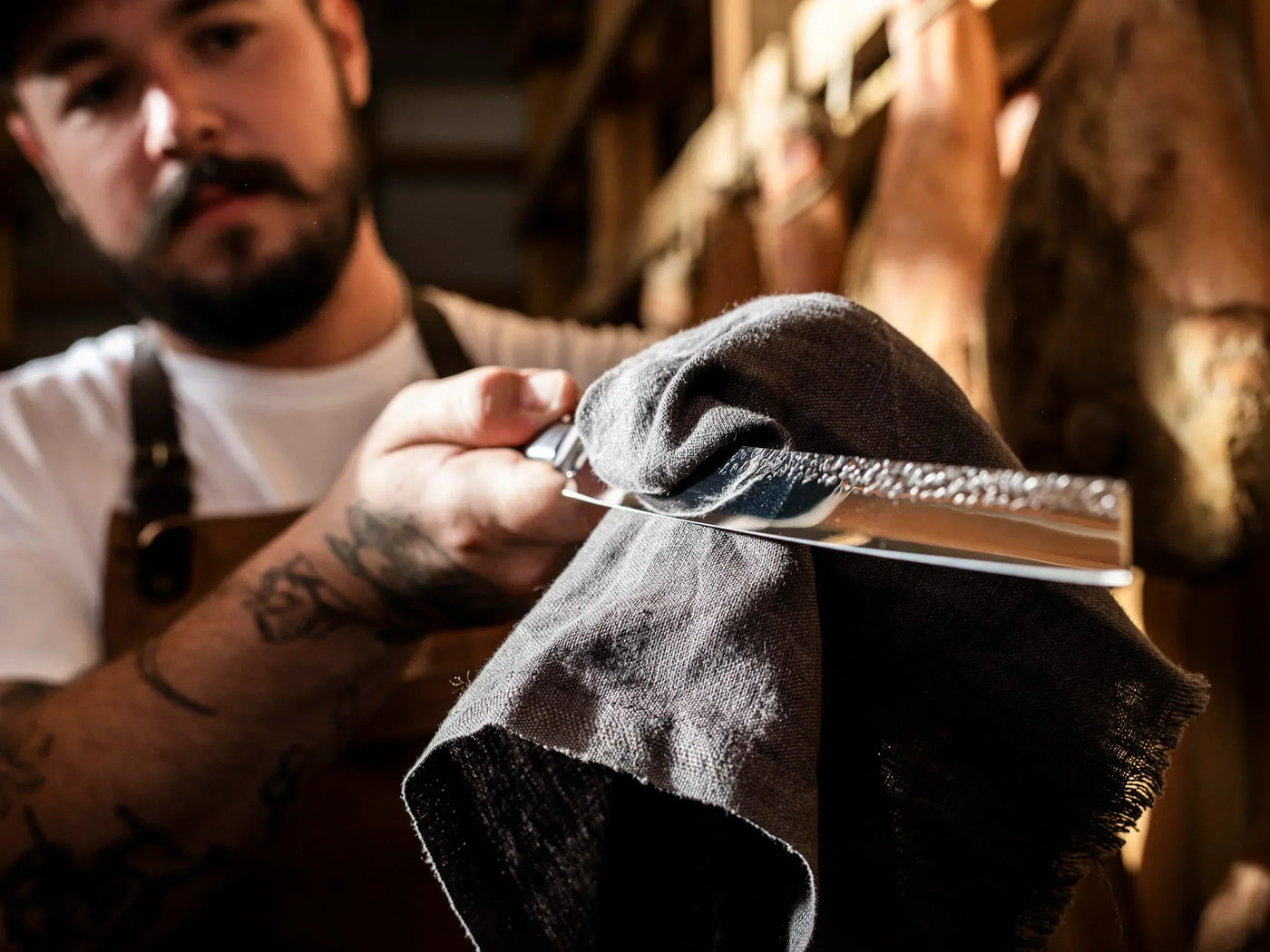
Understanding the different parts of a knife offers a valuable insight into how science, tradition, and technology come together in the production of knives used in the kitchen. Each part contributes to the overall efficiency and functionality of the knife, making it an indispensable culinary tool in the hands of a skilled chef.

The Anatomy of a Japanese Knife
Japanese kitchen knives are made up of many different parts, each with its own unique Japanese name and function. Interestingly, the sections of the blade are likened to parts of the human body—each blade has a spine, the blade curves to form a belly, and ends in a heel.
Blades also differ according to the geometry of their cutting surfaces. The angle of the cutting surface and the type of steel used determine the perfect balance between sharpness and durability.
Basic Parts of a Knife
Cutting Edge / Hasaki: The sharp edge used in cutting, chopping, and other culinary techniques extends the entire length of the blade from the heel to the tip. The hasaki is the part of the blade that first cuts the material, followed by the kireha, which is the primary angle of the blade. Understanding the geometry and structure of the blade is critical to grasping the working principle of Japanese knives.
The term "Hasaki" refers to the intersection point of the beveled surfaces that form the cutting edge of the blade, and it determines the blade's cutting ability. The geometry, angle, and processing of the cutting edge greatly contribute to the blade's functionality.
Kireha: The kireha is the primary angle located just behind the cutting edge, where the blade transitions to its main surface, known as the shonogi line. This is the main section that performs the cutting action and is meticulously designed to ensure sharpness and precision. The sharpening configuration of this angle determines how the blade tapers towards the cutting edge, affecting sharpness, durability, and overall cutting performance.
According to Kireha's angular transition points, blade profiles are divided into three basic types:
- Convex (domed) profile – Provides more durable and stronger cutting.
- Flat profile – Offers a balanced and versatile cutting experience.
- Concave profile – Provides superior sharpness but is also more delicate.
Hagane: Hagane refers to the hard core of high-carbon steel and is the base layer that forms the cutting edge of the blade. This hard core, used in Japanese knives, provides exceptional sharpness and durability.
Jigane: The softer outer layer surrounding the hard core of the blade.
Clad Line: This line marks the junction of the hagane (hard core) and jigane (outer layer). It extends in a wavy line from the heel to the tip of the blade.
Shinogi: The shinogi is a distinctive spine line on the blade, forming the point where the hira surface meets the kireha. In other words, it's the intersection of the hira, the flat surface of the blade, and the kireha, the primary cutting angle. The shinogi is both a structural and aesthetic element. It creates a distinction between the flat and curved surfaces of the blade, allowing for different surface treatments (e.g., kuro-uchi on the top, kasumi on the bottom). If you'd like more information about the surface treatments used on Japanese knives, we have a detailed article on this topic.
In convex blade geometry, there is no shinogi line because there is a continuous curve from the back (mune) to the cutting edge (hasaki).
Hira: The hira is the flat surface extending from the shinogi line to the spine (mune) of the blade. The texture and shape of this surface can determine the degree to which food sticks to the blade. In Japanese knives, hammer marks (tsuchime) are added to the surface to create air pockets, minimizing this. This reduces friction between the blade and the material. The hira can also be used for tasks such as crushing garlic, but caution is advised—improper technique can cause the blade to bend. Such tasks require great care; the blade portion used for crushing garlic must be carefully supported, and the handle should never be pressed against the cutting board.
Blade Back / Mune: The mune is the non-cutting upper edge of the blade, starting from the point where the handle joins the blade. It provides balance and stability to the blade and is used as a reference point in some cutting techniques. In forged Japanese knives, the mune tapers gradually towards the tip; this is called the "distal taper" and is explained in detail in our article on blade geometry.
The thickness of the blade's spine can vary greatly depending on the type and construction of the knife. Single-bevel or double-bevel knives generally have a thicker spine than other areas. Handmade knives with a distal taper are more ergonomic because the wider surface of the spine helps provide a more comfortable grip. The rounded edges and surface finish of the spine enhance comfort during prolonged use and prevent blisters.
Knife Tip & Point / Kissaki: The tip of the knife encompasses the front of the blade, and the point is where the cutting edge joins the spine. The knife tip and point are used for precise and thin slicing of ingredients like onions or shallots, and in meat preparation. In petty knives, the thin and delicate tip is used for small detail tasks, such as removing the eyes from potatoes.
In all types of knives, the tip is used for tenderizing meat, cutting cartilage and tendons. It is also effective for delicate tasks such as deboning chicken and filleting small fish. However, it is very important to use the tip of the knife carefully.
Blade/Sori: The blade is the main working surface. Western-style knives typically have a rounded shape, subjected to more pressure, while traditional Japanese knives have a flatter blade. The curvature of the blade varies depending on its intended use.
* Bunka, nakiri, and santoku knives generally have a straighter blade.
* The gyuto blade has a slight bevel.
The bevel of the blade's cutting edge determines the cutting techniques that can be used. In Japanese knives, a certain portion of the cutting edge is perfectly straight and gradually rises towards the tip of the blade. This straight section is used for cutting larger sections of ingredients and enables the "push-and-pull cut," a traditional cutting technique in Japanese cuisine. This technique differs from the "round-and-cut" technique used in Western cuisine.
The Heel of the Knife / Hamoto: This is the widest part of the knife, closest to the handle. It is used for cutting operations requiring more force. In some cutting techniques, it moves together with the blade body to complete the cutting action.
The heel is generally flatter than other parts of the blade. On curved blades, it can be used by moving it back and forth to quickly and thinly slice vegetables. The thickness and function of the heel vary depending on the type of blade:
* Deba knives are used for cutting fish bones (for thicker bones, softer points such as joint and cartilage tissues should be preferred).
* With santoku knives, the tip of the heel can be used to remove the eyes from the potato.
* With yanagiba knives, when slicing raw fish (when preparing sashimi), the cut starts at the heel and continues upwards.
The tip of the heel can also be used to make holes in ingredients (such as meat or tough vegetables) to shorten cooking time.
Choil / Ago: The choil is the curved section of the blade extending from the handle to the heel. It's the area where the finger makes contact when holding the knife and plays a critical role in providing comfort and control during cutting. Japanese knife makers pay great attention to making this area ergonomic and smooth. In terms of usability, the choil is one of the most important parts of the knife.
A more ergonomic choil makes the knife more comfortable and handy. Japanese knives have a more pronounced choil due to grip requirements, whereas Western-style handles pay less attention to this area.
Machi: Machi is the lower part of the blade where it joins the handle. In Japan's Kanto region, the machi is usually placed with a gap of a few millimeters between it and the handle (machi gap). However, in the Kansai region, the machi is placed closer to the handle.
Tang / Nagako: The tang is the part of the blade that enters the handle and is an extension of the blade's spine. In Japanese knives, it is smaller and thinner compared to Western knives. This shifts the center of gravity of the blade towards the tip, providing a more balanced feel, especially when used with lightweight wooden handles.

ANATOMY OF JAPANESE KNIFE HANDLES
When choosing a quality knife, we can quickly realize the importance of the blade's balance and feel in the hand. Not only the cutting edge of the blade is important, but the quality and construction of the handle are equally crucial. In the case of Japanese knives, there are two main handle types: the Japanese "wa" handle and the Western "yo" handle.
Parts of a Japanese Kitchen Knife Handle
JAPANESE "WA" STEM
The "wa" handle is a characteristic feature of Japanese knives. It basically consists of a wooden handle section (grip) and a ferrule. Some "wa" handles are made from just a single piece of wood and do not include a ferrule.
Handle
The handle surrounds the tang of the knife. When attaching the handle, the tang is heated and pressed into the wood; this causes the wooden section to shrink, providing a secure grip. Sometimes glue is also used. Japanese handles are usually made of natural wood (most commonly magnolia) or sometimes composite materials (such as pakka wood or stabilized wood). The most common shape of handles is oval, suitable for both right- and left-handed users. The octagonal shape is also symmetrical. "D"-shaped handles adapt to the user's hand structure.
More expensive and high-end Japanese knives typically feature octagonal handles made of natural wood, ferrules made of water buffalo horn, and sometimes brass or copper inserts. Special editions may even use silver, which provides antiseptic properties.
Bracelet (Ferrule) / Kakumaki
Kakumaki is the ring located at the top of a Japanese knife handle, where the handle joins the steel. It has several important functions:
* It increases the strength of the handle by ensuring structural integrity.
* It contributes to blade balance, offering a better grip.
* It protects the stem from moisture and swelling, increasing its lifespan.
* It is usually made of plastic or water buffalo horn.
Sap Ucu / Ejiri
This is the bottom or rear section of the handle. In long yanagiba knives, extra support can be added to the handle end to provide balance for heavier knives.
WESTERN-STYLE "YO" STALKS
"Yo" handles are found on Western-style Japanese knives. Their most distinctive feature is that they consist of layers of material surrounding the tang (the metal section that goes into the handle) and are secured with metal rivets. The tang can extend halfway down the handle (partial tang) or spread across the entire handle (full tang). Western-style handles are suitable for those who prefer heavier knives.
Handle Covers
Yo handles are ergonomically shaped. The tang is placed between two layers of material (handle veneers) and secured with metal rivets. These veneers are typically made of plastic, laminated wood, stabilized wood, or sometimes natural wood, bone, or horn. They are highly preferred in professional kitchens due to their durability.
Yo handles are generally sturdier and heavier. Butcher knives, cleavers, honesuki, and boning knives are often manufactured using full tang and yo handles.
Bolster
Some yo handles feature a steel bolster between the blade tip and the handle. This makes the transition between the handle and the blade smoother and more comfortable. Bolsterless handles are also available; bolstered handles are generally slightly heavier.
Rivets
Rivets are metal rods that secure the handle coverings around the tang. Some knives have decorative rivets with a mosaic pattern.
Sap Ucu / Ejiri
The handle is the lower or rear section of the blade and is usually rounded. Some long knives have a support to provide added balance.
Sap Pommeli (Decorative Plate)
It is a decorative section located under the handle, sometimes engraved or hand-carved with kanji. In long and heavy knives, it provides extra support to maintain balance.