
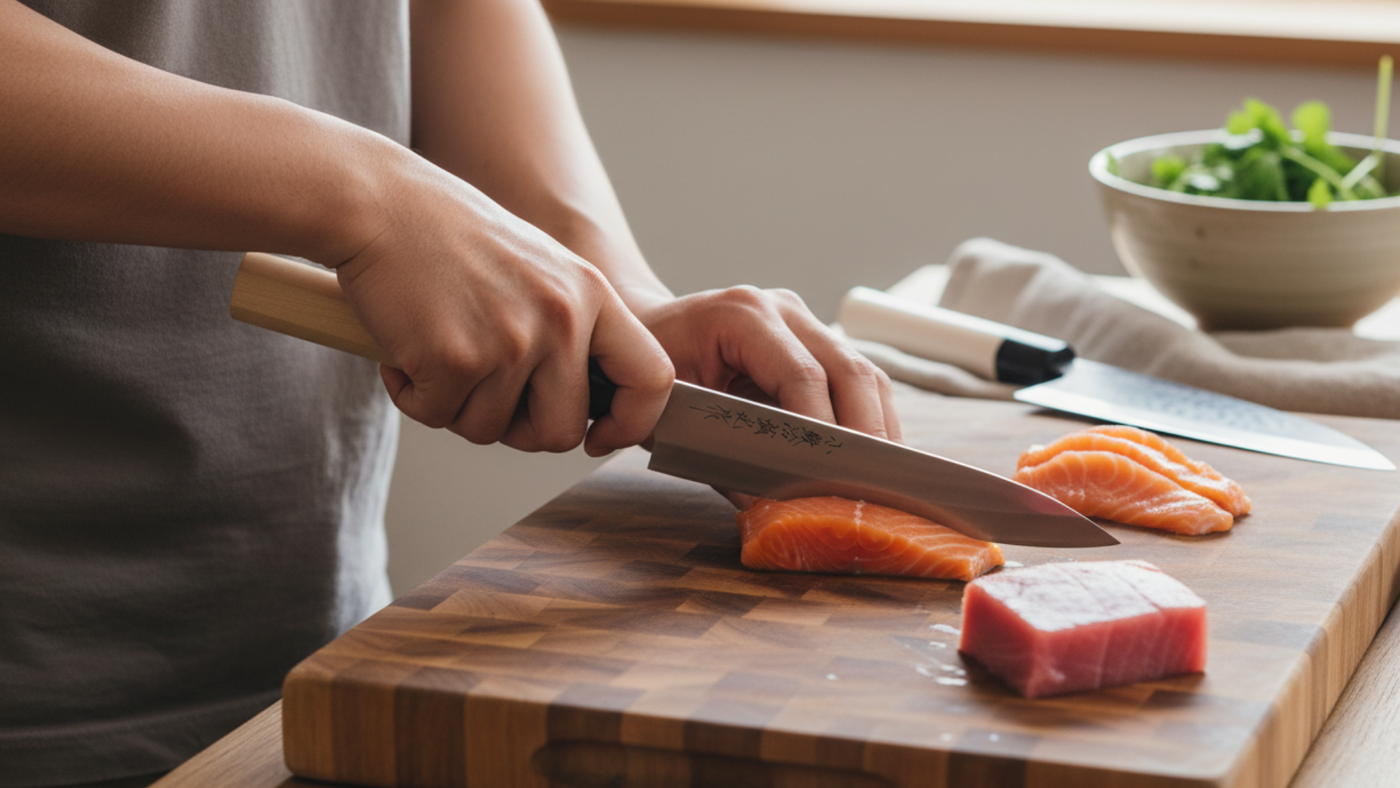
In the culinary arts, the right tools are key to success. Japanese fish knives, in particular, offer a unique level of mastery in preparing fish and seafood. These knives reflect the refinement and precision of traditional Japanese cuisine. Unlike the multi-purpose knives found in Western kitchens, Japanese knives are designed for specific tasks.
The precision inherent in Japanese cuisine is directly linked to the quality of the tools used. Japanese fish knives are the result of a centuries-old blacksmithing tradition. These knives, specifically developed for preparing fish, each serve a different purpose. The Yanagiba , Deba , and Usuba are three of the best-known and most basic models. Each model, with its unique design and function, ensures the flawless preparation of traditional Japanese dishes such as sushi and sashimi. Unlike Western-style knives with double-edged cutting edges, traditional Japanese knives typically have a single-edged cutting edge. This feature allows the knife to cut food in a single, precise stroke without crushing it, thus preserving the texture and flavor of the food. The material of the knife is also very important; they can be made from different materials such as high-carbon steel, stainless steel, and high-speed steels.
The Yanagiba , named after the willow leaf, is a long, thin knife. It's ideal for delicate cuts like sashimi (slices of raw fish) and nigiri (raw fish on rice). The single-sided cutting edge allows you to cut fish fillets in a single, fluid motion. The Deba is a thick and heavy knife. It's designed for heavier tasks like decapitating fish, breaking bones, and filleting. Thanks to its strong construction, it easily breaks apart fish skeletons. The Usuba is a thin, straight-edged knife used for chopping vegetables. It's used for delicate vegetable cuts and preparing garnishes. Together, these three knives form the essential trio in a sushi chef's kitchen. For a chef, this trio is indispensable. Having these knives as good knives at home will also improve your culinary skills.
Geometry and Single-Sided Cutting Edge of Japanese Fish Knives
The most distinctive feature of traditional Japanese knives is their single-edged (kataba) blade. This geometry allows one side of the blade to be straight and the other beveled. This special design allows the knife to cut food with less resistance and more cleanly. The single-edged cut does not damage the texture of the food and provides a great advantage, especially when cutting delicate fish. This is a reflection of the "sharp edge, gentle cut" philosophy in Japanese culinary tradition. The double-edged (ryoba) edges of Western knives are more suitable for chopping and slicing, but they cannot provide the precision of Japanese knives in delicate cuts like sashimi.

The Yanagiba knife, like the willow leaf from which it gets its name, is long and slender. The blade's length is ideal for smoothly slicing raw fish fillets in a single stroke. This preserves the fish's texture and gives the cut surface a bright and attractive appearance. The Yanagiba blade typically has a slightly concave shape, making sharpening easier. Blade lengths can range from 210 mm to 360 mm. While professional chefs often prefer longer blades, shorter models may be more convenient for home users.
You can find our Good Knife - Yanagiba Japanese Knives products here .

The Deba knife is the heaviest and thickest of Japanese knives. Its thick spine and strong construction make it ideal for decapitating fish, breaking bones, and filleting. The weight of the blade makes it easier to cut through tough tissues with less force. The tip of the Deba is designed for skinning fish. The blade is shorter and wider than other Japanese knives, which improves control. Deba knives are generally available in various sizes from 150 mm to 240 mm and are one of the most trusted tools of a fish chef.
You can find our Good Knife - Deba Japanese Knives products here .
The Usuba knife, whose name literally means "thin blade," lives up to its name. It has a thin, straight blade. It is ideal for complex vegetable cutting techniques, such as "katsuramuki" (thin, circular slicing), which are frequently used in Japanese cuisine. The straight cutting edge of the blade allows for precise slices of vegetables without crushing them. (Japanese fish knives) Although the term is often associated with fish, knives like the Usuba have a wide range of uses in the kitchen.
Japanese Fishing Knife Handles and Accessories
Japanese knives generally have handles that fall into two categories: traditional Japanese style (Wa-handle) or Western style (Yo-handle). Traditional handles are typically made from materials like magnolia or ebony, helping to balance the knife's center of gravity. These handles provide the user with better control and balance. Western-style handles, on the other hand, are generally more ergonomic and are more commonly used in modern kitchens. The material of the blade also determines its performance. High-carbon steel offers incredible sharpness and edge retention, but it is more susceptible to rust. Stainless steel requires less maintenance, but it cannot maintain an edge as sharp as carbon steel.
Choosing Japanese fish knives requires considering these details. Each knife's unique design and function make it one of a kind in the kitchen. Selecting the right knife means understanding not just a tool, but also a culinary tradition and art. These knives can be the most valuable investment in your kitchen.
You can find our Good Knife | Fishing Knives products here :
Features of Japanese Fishing Knives
One of the most important characteristics of Japanese knives is the quality of the steel used. Traditional Japanese knives are usually made from a special steel called "tamahagane." Nowadays, however, high-carbon steels such as Aogami (Blue Paper) and Shirogami (White Paper) are commonly used. These steels allow the blade to maintain an incredibly sharp edge. The single-sided cutting edge of the blade maximizes this sharpness. This sharpness allows you to cut food in a single, precise stroke without crushing it, thus preserving the texture and flavor of the food. This forms the basis of Japanese fishing knives such as the Yanagiba, Deba, and Usuba.
Japanese fish knives are designed to fit perfectly in the user's hand. Traditional Japanese handles (wa-handles) help to properly balance the center of gravity of the blade. This minimizes hand fatigue, even during prolonged use. The balance of the blade increases control during precise cuts and requires less effort from the user. This ergonomic design ensures that the knife goes beyond being just a tool and becomes an extension of the user.
Each Japanese knife is designed for a specific task. This functionality increases efficiency in the kitchen. The Yanagiba is used solely for sashimi, the Deba for cutting and deboning fish heads, and the Usuba for precisely slicing vegetables. This purpose-built design ensures that each knife performs its function optimally. These specialized knives flawlessly accomplish tasks that a multi-purpose chef's knife cannot. This is one of the key reasons for choosing the right Japanese fish knives: Yanagiba, Deba, Usuba. Each of these knives is a specialized tool that solves a problem in the kitchen.
Why do Japanese fish knives have a single-sided cutting edge?
The single-sided cutting edge of traditional Japanese knives is designed to cut through food in a single, precise stroke without crushing it. This design allows the blade to glide over the food with less resistance, ensuring a smooth cutting surface. This precision is vital, especially when preparing raw fish like sashimi, to preserve the texture and flavor of the food. This is a hallmark of Japanese fish knives such as the Yanagiba , Deba , and Usuba .
Which Japanese fishing knife is the right choice for me?
Choosing the right Japanese knife depends on your culinary habits and needs. If you frequently prepare sushi and sashimi, the Yanagiba would be the best choice. For heavier tasks like deheading and bone-removing fish, the Deba is ideal. If vegetable garnishes and thin slicing are important to you, you should opt for the Usuba . If you are looking for a versatile, good knife for general use at home , you can also consider double-edged knives like a santoku or chef's knife. However, if you want to experience the precision and quality of Japanese knives, you should choose the model that best suits your needs.
If you're asking, "Which Japanese knife should I use?", you can decide on the most suitable Japanese chef's knife for you here with a few answers: "Find the Right Chef's Knife for You"
How do you care for Japanese fishing knives?
Caring for Japanese knives is crucial for their longevity and sharpness. Never wash them in a dishwasher, as this can damage the handle and blade. Wash the knife with warm water after each use and dry it immediately. Regularly sharpening the knives with a whetstone is important for maintaining their sharpness. Since high-carbon steel knives are more prone to rusting, it's important to dry and oil them immediately after use. You can find more information about knife care via the external link.
What is the difference between Yanagiba and Deba knives?
Yanagiba and Deba , although both are Japanese fish knives , serve different purposes. The Yanagiba is a long, thin blade used for delicate slicing of raw fish, such as in sashimi. Its purpose is to make a smooth cut in a single, fluid stroke. The Deba, on the other hand, is a shorter, thicker, and heavier blade. Its purpose is to cut off the head of fish, remove bones, and perform heavier butchering tasks. In short, the Yanagiba is designed for cutting, while the Deba is designed for butchering.
Why are Japanese fishing knives sharper than Western knives?
There are several reasons why Japanese knives are generally sharper than Western knives. First, traditional Japanese knives are made from harder steels, which allows the sharper edge to be retained for longer. Second, the single-sided cutting edge allows the blade to be sharpened at a finer angle, thus resulting in greater sharpness. Third, the Japanese blacksmithing tradition places great emphasis on the knife forging and sharpening processes. The combination of these factors creates the superior sharpness of Japanese knives. This is one of the most important factors that makes them good knives .