
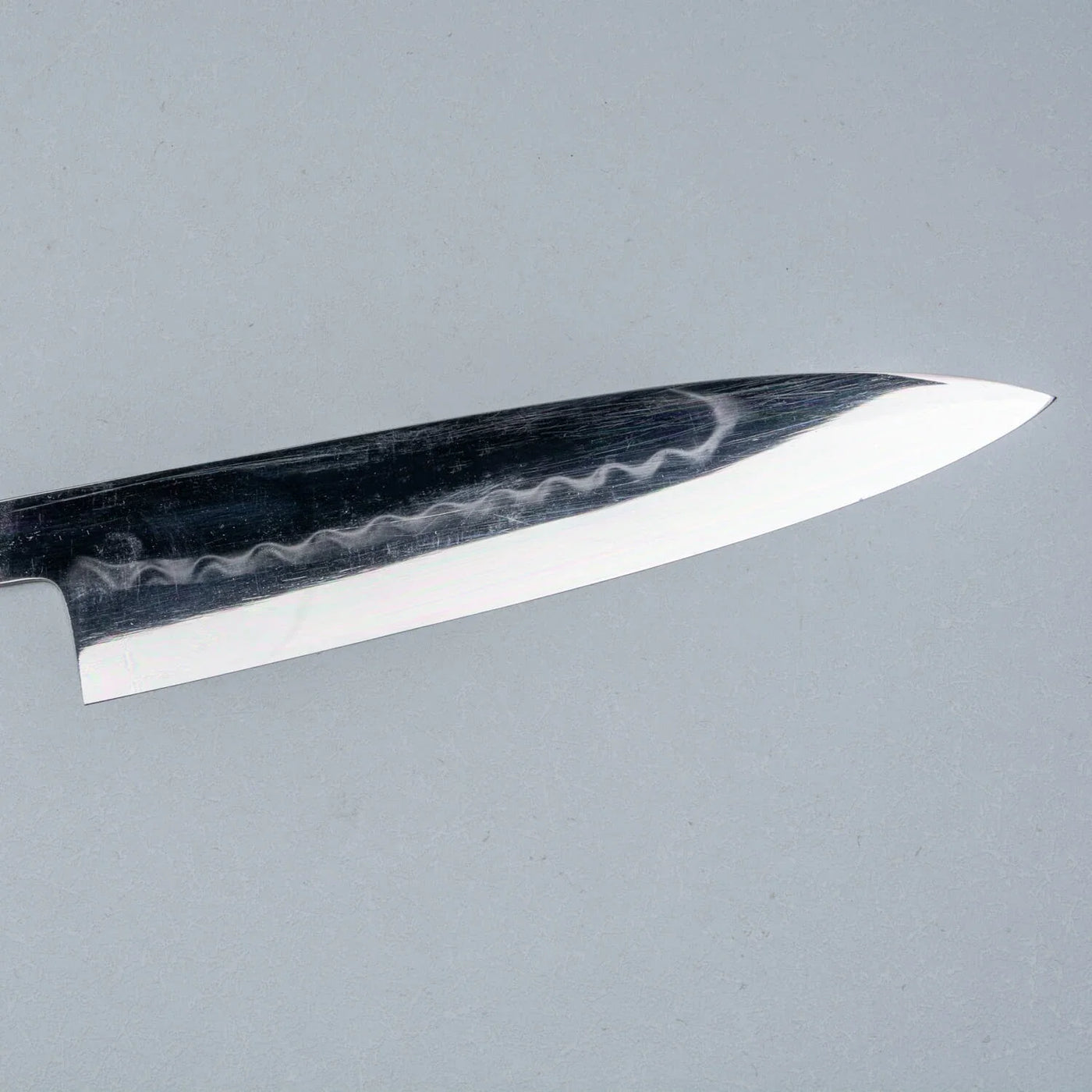
Honyaki is one of the purest and most traditional methods of Japanese knife making. This special technique relies on a production process that requires high precision and years of experience, applied only by master blacksmiths. Honyaki knives are made from a single piece of steel, thus achieving an unparalleled level of both visual appeal and performance.
What is Honyaki?
Honyaki (本焼) means "truly heat-treated." This technique is very similar to the methods used in the production of nihonto , traditional Japanese swords. Honyaki blades are made from a single piece of high-carbon steel, unlike san-mai or warikomi styles where multiple layers of steel are laminated.
One of its most striking features is the hamon line , which forms after the water-hardening (quenching) process. This line ensures high hardness of the blade's sharp edge and flexibility of the spine. This water-based treatment indicates that the blade is a "mizu honyaki".
Types of Steel Used and Different Hardness Levels
Honyaki knives are made using special steels produced in Japan. These steels include:
- Shirogami (White Steel) : One of the purest carbon steels, it is easy to sharpen. However, care should be taken to prevent rust.
- Aogami (Blue Steel) : It is more durable due to its chromium and tungsten content. It is a steel frequently preferred by professionals.
- Tamahagane : This is traditional Japanese steel and can only be used by a limited number of skilled craftsmen.
- Ginsan (Gingami) : A modern option with a traditional form and stainless steel properties.
Thanks to these steels, Honyaki knives generally reach a hardness of 62 HRC and above. This is one of the most important factors that places them in the " best knives " category.
Honyaki Production Process: Craftsmanship and Tradition
Each Honyaki knife is coated with a special mixture of clay, charcoal, and water, then heated in a controlled manner and cooled by immersion in water. This process is extremely difficult to perform; hardening at the wrong temperature or angle can cause the blade to crack.
Therefore, Honyaki production is only possible with a limited number of Japanese masters. Leading masters include Kenji Togashi, Yoshikazu Tanaka , and Satoshi Nakagawa .
Sharpening and Maintenance Challenges
Honyaki knives, with their high hardness, stay sharp longer than ordinary steel knives. However, this characteristic makes them more challenging to sharpen. Honyaki knives must be sharpened carefully, at the correct angle, using the right whetstone or sharpening steel. Otherwise, the edge structure can be damaged.
Why Choose Honyaki?
Honyaki knives are not just a kitchen tool, but also a living part of craftsmanship and Japanese culture. They are an ideal choice for professional chefs seeking performance or for enthusiasts looking for pieces with collectible value.
- Long-lasting sharpness
- High hardness and stable structure.
- Handmade and limited edition.
- Aesthetically unique hamon line
Conclusion: Honyaki, the embodiment of true mastery.
Honyaki knives represent the pinnacle of Japanese knife-making, both technically and artistically. They stand out in every aspect, from the production process and the special steels used to the aesthetic details. A favorite among professionals and a prized possession for collectors, discovering a Honyaki is the most refined way to pay homage to Japanese craftsmanship.