
When selecting a type of steel, blacksmiths consider factors such as how long the sharpness will last, ease of maintenance and sharpening, as well as the price and availability of the steel. All of these practical characteristics are directly related to the hardness of the steel; hardness is the most important property used in evaluating tool (table) steels.
Hardness, by definition, is the resistance of a material to change in shape (permanent plastic deformation). Therefore, it also means resistance to wear. The hardness of a metallic material is determined by its chemical composition and thermomechanical processing. Carbon is the chemical element that most affects the hardness of steel; elements such as chromium, manganese, vanadium, and molybdenum also positively influence the hardness of steel. These elements, together with carbon, form extremely hard compounds called carbides.
The link between hardness and carbon content can be clearly seen in the following example: the higher the carbon content, the higher the HRC of the steel.
White Steel 1 / 63 HRC / C = 1.25-1.35%
White Steel 2 / 61-62 HRC / C = 1.05-1.15%
White Steel 3 / 60 HRC / C = 0.80-0.90%
Hardness Scales and HRC Measurement
Rockwell Hardness Scale
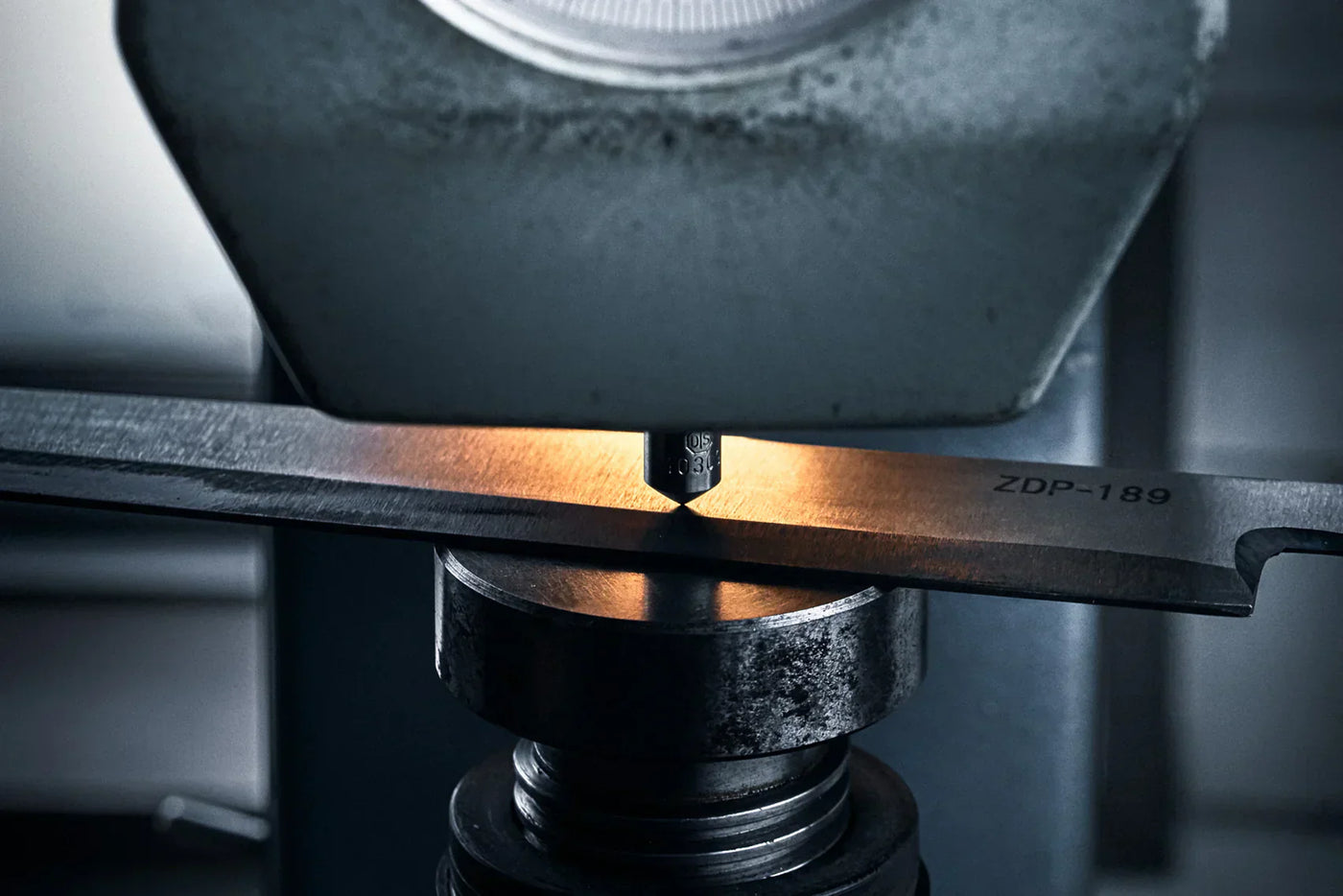
HRC is one of the most commonly used methods for measuring the hardness of steels, such as those used in knives. In this method, a diamond cone is pressed into the steel with a specific force. The depth of the indentation created by the cone's penetration into the surface is measured. This depth determines the hardness of the steel and is usually expressed as HRc (Rockwell C). This process is quick, simple, and provides direct results, which is why it is so common in determining the hardness of steels.
How is HRC Measurement Performed?
A specialized device is used for HRC hardness measurement. This device has three main parts: an anvil, a diamond cone, and a measuring gauge. First, the steel sample is placed on the anvil and a low force is applied. Then, a higher force is applied, and the depth to which the cone penetrates the steel is measured. This depth is directly related to the hardness of the steel. The measured depth gives the Rockwell C hardness rating and is usually shown on a scale from 0 to 100.
Validity and Significance of HRC
HRC is a widely accepted and trusted hardness measurement system worldwide. Knife manufacturers prefer HRC measurement when determining the hardness of high-quality steels, especially Japanese steels. Hardness is a significant factor affecting a knife's ability to stay sharp for a long time. A high HRC value means the blade's fine cutting edge will last longer, but high hardness can also lead to the blade being more brittle. Therefore, it is important to strike a balance between hardness and durability.
HRC and Blade Performance
The HRC rating directly affects the sharpness, durability, and lifespan of a knife. For example, knives with an HRC rating of 60+ can stay sharp for longer, have fine cutting angles, but may become brittle if misused. Knives with lower hardness ratings may be more durable, but they may lose their sharpness more quickly and require more frequent sharpening.
In conclusion, the HRC value plays an important role in understanding the quality and intended use of knives. The ideal HRC value for high-quality, long-lasting knives is generally between 60-62.
Hardness Levels and Usage Characteristics
56 HRC and below: Kitchen knives with a hardness level starting from 56 HRC lose their sharpness quickly and are more difficult to sharpen. However, these knives are more durable and more resistant to deformation.
60-62 HRC: Most Japanese knives have a hardness level in this range. These knives stay sharp for a long time and are easy to sharpen thanks to their steel construction. However, they are prone to breakage and damage with improper use.
64-68 HRC: Modern powder metallurgy steels have the highest hardness on the Rockwell scale, ranging from approximately 64-68 HRC. These steels are rare (and therefore more expensive) and difficult to machine, but when used correctly, they maintain their sharpness for an incredibly long time. They also require more precision and care when sharpening.